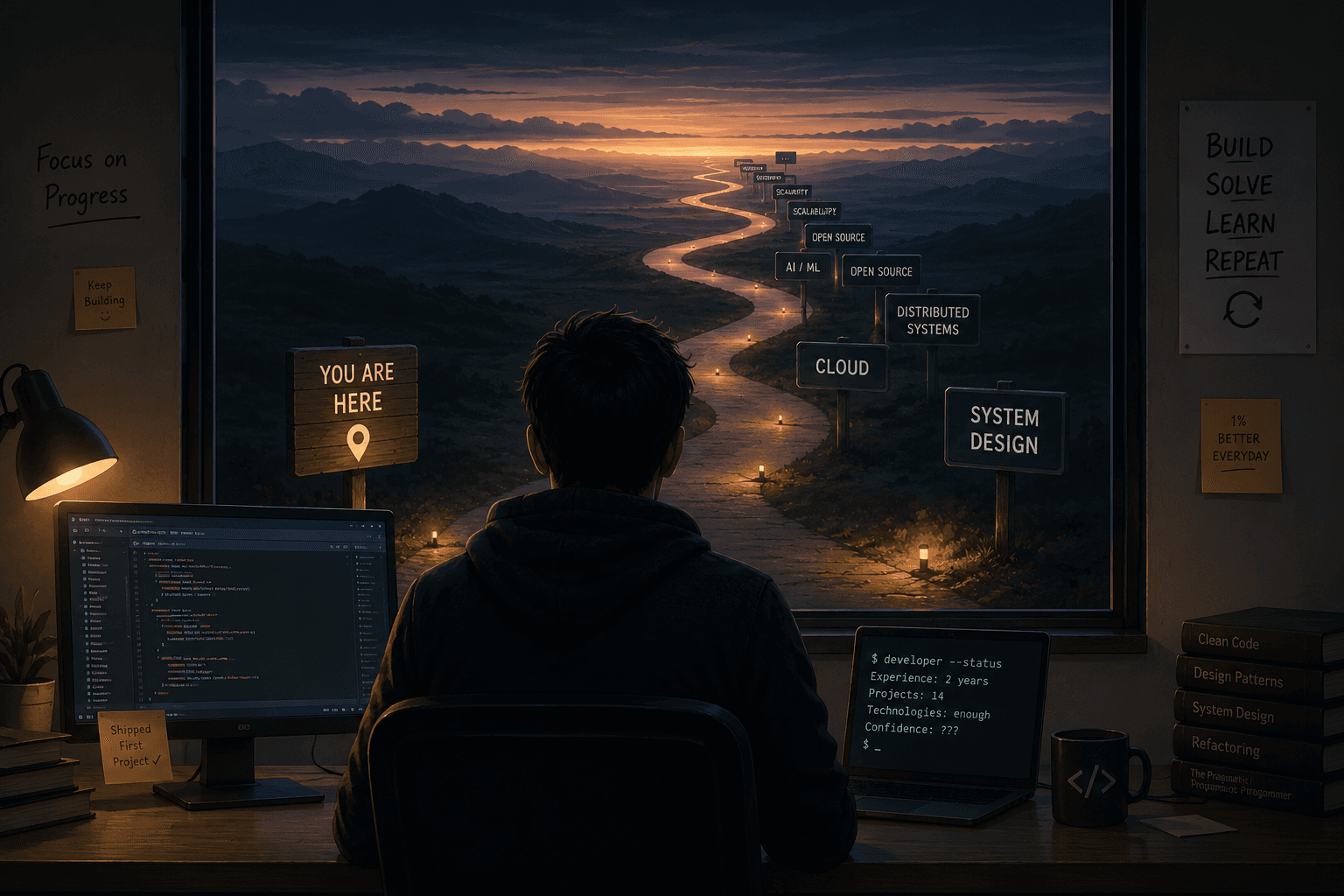
Why Developers Struggle With Emotions
(And Why That's Completely Normal)

"Bro, I can debug a distributed system, deploy a production app, and solve 200 LeetCode problems... but I still don't know what to reply when someone says, 'I'm upset.'"
If you're a developer, chances are you've experienced something similar.
And if you haven't...
You're probably lying. 😄
The Day I Realized I Was Treating Emotions Like Bugs
A few months ago, someone close to me was having a difficult day.
They told me they were feeling stressed, overwhelmed, and emotionally exhausted.
My developer brain immediately booted up.

Like a production server after a restart.
Within seconds I had:
3 solutions
2 backup plans
A Notion template
A roadmap
And probably a five-year vision document


In my head:
"Problem identified. Solution incoming."
Me when someone says they're sad:

Task detected.
Generating solutions...
Please wait...
Then came the response.
"I wasn't asking for solutions."

My brain crashed harder than Internet Explorer.
Developers Have a Dangerous Superpower
We are trained to solve problems.
That's literally our job.
Bug?
Fix it.
Slow query?
Optimize it.
Server down?
Restart it.
Memory leak?
Patch it.
Life would be amazing if human emotions worked the same way.
Unfortunately, they don't.
Because emotions aren't bugs.
They're experiences.
And that's where many developers struggle.
We're trained to solve.
But people often need understanding before solutions.
The "I'm Fine" Problem
Every developer has encountered this.
Someone says:
"I'm fine."
And immediately your brain knows something is wrong.
Because "I'm fine" is the emotional equivalent of:
Everything is working perfectly.
Written in a README that hasn't been updated since 2018.
$ relationship-status

Status: Fine

Logs:
[ERROR] User cried 2 hours ago
[WARNING] Communication disabled
[WARNING] Emotional battery low
The problem is what happens next.
Instead of listening, we start debugging.
Developer Debugging Process

Step 1:
Ask 12 questions.
Step 2:
Provide 7 solutions.
Step 3:
Turn conversation into technical interview.
Step 4:
Wonder why the other person is annoyed.
Human Beings Don't Come With Documentation

This is probably the most unfair thing about life.
Frameworks have documentation.
Libraries have documentation.
APIs have documentation.
Even my blender has documentation.
Humans?
Nothing.
No README.
No API reference.
No setup guide.
No troubleshooting section.
Just vibes.
Imagine if humans actually came with documentation.

name: Human

known_triggers:
  - hunger
  - stress
  - lack_of_sleep

recommended_response:
  - listen
  - reassure
  - be_present

avoid:
  - unsolicited_advice
  - comparison
  - judgement
Life would be significantly easier.
Unfortunately, we're all running undocumented software.
We Treat Relationships Like Side Projects
This one hurts.
Because I've done it myself.
Many developers spend:
8 hours working
2 hours learning
1 hour watching productivity videos
1 hour watching coding tutorials
And then give relationships whatever energy remains.
Which is usually:
3% battery.
Yet somehow we expect our relationships to thrive.
Imagine opening your startup project once every two weeks and saying:
"Why isn't this growing?"
That's exactly what many of us do with relationships.
Relationships need maintenance.
Updates.
Communication.
Attention.
The same things we happily give our codebase.
Emotional Technical Debt Is Real

Developers understand technical debt.
Skip the fix today.
Pay the price tomorrow.
Emotions work exactly the same way.
Every:
avoided conversation
ignored concern
unspoken frustration
unresolved misunderstanding
creates emotional debt.
At first everything seems okay.
Then one day:
(Production outage)

Suddenly you're discussing something that happened three months ago.
And you're sitting there like:
"Wait... we're still talking about THAT?"
git status

Changes not committed:

- unresolved argument
- ignored concern
- postponed conversation

Warning:
Emotional debt increasing.
The logs were there.
You just never checked them.
Why Developers Overthink Everything
Developers love patterns.
We are basically highly optimized pattern-recognition machines.
Which is amazing.
Until emotions enter the chat.
For example:
Someone replies after 2 hours.
Normal brain:
"They're probably busy."
Developer brain:

if(reply_delay > normal){
   assumeWorstCaseScenario();
}
She replied after 2 hours.

Possible reasons:
✓ Busy
✓ Sleeping
✓ Working

Developer brain:
✓ Relationship ended
✓ Moving to another country
✓ Joined a monastery
✓ Witness protection program
We take one small event and simulate seventeen possible futures.
Most of them completely fictional.
The Biggest Lesson I'm Learning
This is something nobody taught me.
Not every feeling needs fixing.
Not every conflict needs winning.
Not every uncomfortable moment means something is broken.
Sometimes people simply want to be understood.
And honestly?
That was difficult for me to learn.
Because helping and fixing felt like the same thing.
But they're not.
Sometimes the best response isn't:
"Here's what you should do."
It's:
"That sounds difficult."
One sentence.
No solution.
No optimization.
No roadmap.
Just understanding.
And strangely enough, that often helps more.
The Best Developers Eventually Learn This

As your career grows, something interesting happens.
You realize coding isn't the hardest part anymore.
People are.
The engineers everyone loves working with usually aren't the smartest.
They're the ones who:
communicate clearly
listen carefully
handle disagreements respectfully
make others feel heard
Technical skills get you into the room.
People skills determine how far you go.
Human Beings Are Not Databases
Another mistake developers make.
We sometimes treat people like databases.
We query information only when needed.
SELECT feelings
FROM partner
WHERE problem = true;
Unfortunately, that's not how relationships work.
People aren't databases.
Relationships require continuous connection.
Not occasional queries.
ERROR:

Relationship connection lost.

Reason:
No meaningful conversation found
in last 14 days.
Final Commit
I still love logic.
I still love systems.
I still love solving problems.
But lately I've been learning something important.
Human beings are not bugs to fix.
They're stories to understand.
Maybe that's why developers struggle with emotions.
We've spent years learning how computers work.
Now we're trying to learn how humans work.
And honestly?
Humans are significantly more complicated than software.
But they're also far more interesting.

Things I'm slowly learning:

✓ Listen more
✓ Solve less
✓ Assume less
✓ Ask more
✓ Be human first

Version:
HumanOS v1.0
Closing Thoughts
If you've ever:
Overthought a text message
Tried to optimize a relationship
Turned an emotional conversation into a debugging session
Solved a problem nobody asked you to solve

Congratulations.
You're probably a developer.
And you're definitely not alone.
We're all learning.
One bug.
One conversation.
And one relationship at a time.
❤️ Thanks for reading
If this resonated with you, share it with your developer friend who thinks every emotional problem can be solved with a flowchart.